AI Jewelry Models: The Difference Between a Beautiful Image and a Production-Ready 3D Model
Artificial intelligence has already changed the way designers create ideas. Today, AI can generate impressive concepts of rings, pendants, and other jewelry pieces within seconds. For inspiration, brainstorming, and exploring new design directions, it has become one of the most powerful tools available.
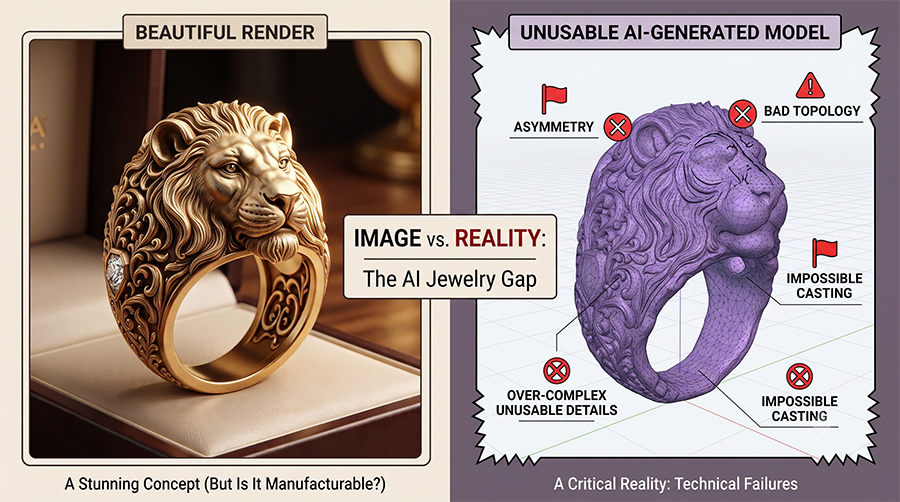
However, there is still a significant difference between a beautiful AI-generated image and a professional jewelry 3D model ready for manufacturing.
A realistic render can create the impression that the design is perfect. The lighting is beautiful, the materials look expensive, and the details appear impressive. But when the actual 3D model is examined, many hidden problems can appear.
AI is improving rapidly, and perhaps in the near future it will solve many of these challenges. But today, AI-generated jewelry models still have limitations that every jeweler and 3D artist should understand.
A Beautiful Render Does Not Always Mean a Good STL File
One of the biggest misunderstandings about AI-generated jewelry is confusing visual quality with manufacturing quality.
A jewelry designer or customer looking at a render usually asks:
"Does this design look attractive?"
A professional jeweler asks different questions:
- Can this model be milled?
- Can it be cast successfully?
- Are the details strong enough?
- Will polishing destroy the surface?
- Are the proportions correct?
- Is the structure symmetrical?
- Is there enough material thickness?
A model can look amazing on a screen and still be unsuitable for real production.
Main Problems of Current AI Jewelry Models
1. AI Does Not Understand Manufacturing Requirements
AI is excellent at creating shapes and visual concepts, but it does not truly understand the physical process of making jewelry.
A human jewelry modeler thinks about:
- casting limitations;
- CNC milling;
- stone setting;
- polishing;
- metal strength;
- production costs.
AI mainly focuses on appearance.
The result can be a design that looks impressive but has serious technical problems.
2. Incorrect Symmetry
Many jewelry designs require precise symmetry.
A human modeler can create one half of a ring and mirror it perfectly.
AI-generated models often create the illusion of symmetry, but when examined closely:
- the left and right sides may differ;
- decorative elements may not match;
- curves may have different shapes;
- details may shift randomly.
For a professional jewelry piece, these small differences can become major defects.
3. Random Decorative Details
AI can create beautiful patterns and complex ornaments.
The problem is that these details often do not have a logical structure.
You may find:
- elements that suddenly disappear;
- inconsistent thickness;
- random transitions;
- shapes that look decorative but have no engineering purpose.
A professional jewelry design is not only decoration. Every element should have a reason.
4. Undercuts and Problematic Geometry
Some issues are invisible in a render.
A camera angle can hide problems that become obvious during production.
Examples:
- inaccessible areas for milling tools;
- negative angles;
- impossible transitions;
- areas where material cannot be removed or polished.
A production model must be designed with manufacturing limitations in mind.
5. Incorrect Thickness
One of the most important aspects of jewelry modeling is material thickness.
AI may create extremely thin elements because they look elegant in an image.
But in reality:
- they may break during casting;
- they may disappear during polishing;
- they may become too fragile for everyday use.
A beautiful shape must also be physically possible.
6. Details That Exist Only on the Screen
AI often creates extremely fine surface details.
They may look impressive in a close-up render, but after manufacturing:
- small textures can disappear;
- sharp edges become rounded;
- details become impossible to reproduce.
A professional modeler understands which details will survive in real metal.
7. Uncontrolled Surface Quality
AI-generated geometry may contain:
- uneven surfaces;
- unnecessary bumps;
- irregular topology;
- unwanted distortions.
These problems are often invisible in a static image but become noticeable when the model is rotated or prepared for production.
AI Is a Powerful Tool — But It Still Needs Experience
The goal is not to fight AI.
AI is an excellent generator of ideas.
The real challenge is understanding the difference between:
"A beautiful concept"
and
"A professional jewelry model that can become a real product."
This is where human experience remains valuable.
A skilled jewelry 3D artist can take an AI-generated idea and transform it into a model that respects:
- design principles;
- manufacturing technology;
- customer expectations;
- real-world limitations.
The Future of Jewelry Design
AI will continue to improve. Future systems may become much better at creating production-ready models.
But until that happens, professionals need to evaluate AI results critically.
The question is not:
"Was this model created by AI?"
The better question is:
"Can this model become a real piece of jewelry?"
Because in the jewelry industry, the final result is not a beautiful image.
The final result is a physical object that someone will wear, manufacture, and sell.
The future probably belongs not to those who reject AI, but to those who understand how to combine AI speed with human expertise.